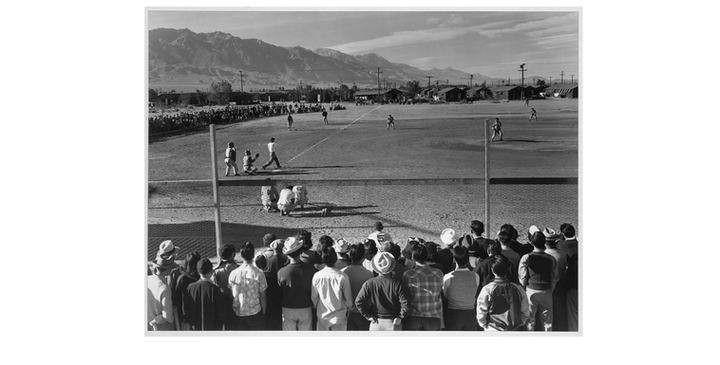
Without knowing how long WWII would last or how long they would be imprisoned, Japanese Americans were forced to adjust to their new life. The barracks, and the land surrounding them, was dirty and dead with the land stretching out across acres with nothing in sight but the barbed wire fence surrounding each camp. Entertainment was scarce as well. Besides there being other kids to play with, there were few activities to participate in to pass the time. The kids still went to school yet their situation wasn't exciting at all.
The Japanese Americans were beginning to feel, if they hadn’t already, hopeless and lost without much direction to their way of life now. There wasn’t much to look forward to, and as the days stretched on, it began feeling as though the war would never end. That was when many of the Japanese Americans turned to the sport of baseball as a way to escape feelings of boredom and loneliness.
Many kids had played baseball before internment and it was a popular sport among not only Japanese Americans, but kids in general. Additionally, adults enjoyed watching the games and cheering the kids on. In order to carry out this idea, Japanese Americans decided to create baseball diamonds, and use their limited resources to build bleachers, bases, and backstops to create baseball fields. Sometimes, mothers and other women would sew jerseys for the players out of old curtains or bed sheets to give them a feel for the real game.
A book that touches on this topic deeply is Baseball Saved Us by Ken Mochizuki. While he explains the concept of baseball in Japanese Internment Camps and its significance to the tolerance of the camps, he also explains the significance of the guard towers and the guards in them that were constantly scanning every inch of the camps.
He also describes how those incarcerated felt the pressure and need to prove themselves to those guards as they watched over them, specifically from the perspective of the main character, nicknamed “Shorty,” who felt as though the guard was disappointed in him every time he struck out during the games. Overall, baseball’s contribution was great due to its ability to not only instill morale in Japanese Americans, but to also provide an underlying strength for them to keep fighting through their injustice.
