What Was Japanese American Internment?
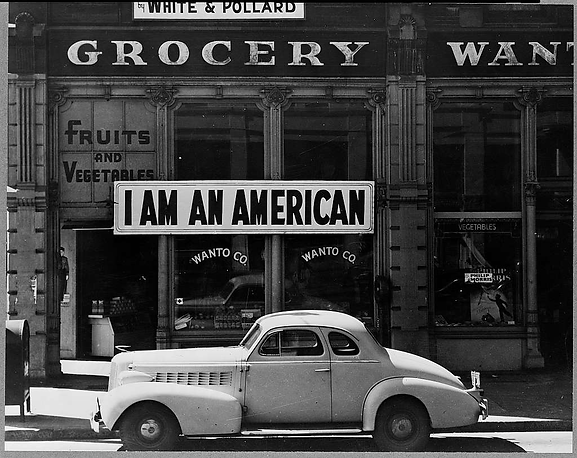
Japanese American Owned Grocery Store In Okland, Calfornia. Courtesy of Picryl.
On February 19, 1942, President Franklin D. Roosevelt signed his name under Executive Order 9066. For him, it was a routine signature. One he’d done many times before. Yet for thousands of Japanese Americans across the United States, it was the day their freedom was taken, not for what they had done, but for who they were.
Roosevelt signed 3,725 Executive orders during his time as the President of the United States. He signed Executive Order 7034 which established the Works Progression Administration and created jobs for millions, as well as Executive Order 6581 which created the Export-Import bank to facilitate trade. So what was one more? Especially about a population that none really considered American anyway? How could a single signature, buried among thousands, quietly dismantle the lives of innocent families?
In 1941, 353 Japanese aircraft attacked Pearl Harbor, destroying 151 aircraft overall and ending more than 2,300 American lives, leading to the start of WWII. Executive Order 9066 authorized the Secretary of War to designate military zones, leading to the forced relocation and incarceration of over 120,000 Japanese Americans due to the fear that Japanese Americans might commit treason against the United States by communicating with Japan. Issei farmers (first generation Japanese Americans) were banned from owning any land, and lost all their rental or lease agreements when WWII started.
“Within six months of the executive order being signed, men, women and children were forcibly moved to ‘assembly centers'" (National Archives) where they were then transferred to prison camps. During the time between relocation and arrival at the internment camps, Japanese Americans were forced to live in horse stables where the stench was unbearable and the space was crowded. Generally, three to six people were crammed like animals into a 10x20 foot horse stall that had no floors and no room for privacy.
There were 10 Internment camp sites across the United States: Heart Mountain (Wyoming), Tule Lake and Manzanar (California), Topaz (Utah), Poston and Gila River (Arizona), Granada (Colorado), Minidoka (Idaho), and Jerome and Rohwer (Arkansas). Many of these names originated from nearby landmarks or local geography, in order to keep track of their locations.
The barracks (“homes” for the Japanese Americans during the war in the internment camps) were constructed poorly. With no insulation, the shacks were freezing in the winter and insufferably hot in the summer. Families of 6 were packed tightly into rooms of around 20x24 feet, only slightly bigger than the horse stalls they stayed in previously. Additionally, dust storms were a regular occurrence. Wind speeds were so fast, that the accumulation of dust and wind burnt the Japanese American’s eyes and required immediate cover to stay safe. On top of that, armed guards in guard towers surveyed the camps 24/7, and barbed wire fences surrounded the entire area.
After 4 years, Japanese Americans were finally released from the camps due to the December 1944 Supreme court ruling which deemed the incarceration of loyal U.S. citizens unconstitutional. Most Japanese Americans were released in 1945, but some, specifically those in Tule Lake and Manzanar were not released until 1946. President Roosevelt never publicly apologized to the Japanese Americans.
When the Japanese Americans returned, nothing was how it had been before. Stripped of their belongings, many Japanese Americans were left with nothing. No land, no money, and no connections. Some families were fortunate enough to have had a neighbor take care of their land, but the majority of the Japanese Americans were left with their property stolen after the long amount of time they had been gone. Despite all of these challenges, Japanese Americans have continued fighting. They have worked hard to come back from such a devastating event, and have shown strength through their challenges.
As you explore this site and read this history from Arroyo Grande, a small agricultural town whose population consisted of over 43% Japanese Americans before WWII, I invite you to consider the families who once walked these same streets, worked these same fields, and called this town home - and to reflect on what their story teaches us about justice, belonging, and resilience.